Jack Harper
Can You Keep a SecretJack Harper is Panther Corporation’s joint founder, an influential business figure whose polished public identity contrasts with the private life he carefully guards. Through Emma Corrigan’s encounters with him, that reserve becomes both an attraction and a source of conflict: he listens closely to what she reveals, but does not offer the same access to himself. Their relationship is tested when he takes her confidences into public view, then slowly reframed as he discloses the sensitive family truth behind one of his silences.
Identity and Business Background
In Panther Corporation’s office, Jack’s arrival is treated as an exceptional occasion. The company’s history is bound up with his: in 1987, he and Pete Laidler bought the ailing Zoot soft-drinks company, repackaged Zootacola as Panther Cola, and created the Don’t Pause slogan. Emma knows this account not through personal acquaintance but through repeatedly typing promotional blurbs about him, an early measure of the distance between the famous founder and the employee who has encountered his story as corporate copy.
Paul introduces Jack to the staff as the company’s founding father, a man who has influenced and inspired a generation of marketers. Jack responds to the applause by asking for no fuss and for everyone to carry on as usual. He then walks around the office, stopping to talk with employees as Paul makes introductions. His modest manner does not erase his authority: the room’s excitement, and the care with which Paul stages the introductions, make his status unmistakable.
From a Flight to a Private Confidence
Emma’s personal connection with Jack begins in a very different setting from the office celebration. During a turbulent flight, she believes they may die and blurts out her private thoughts to the stranger beside her. When the turbulence has passed, she remarks that they are no longer bumping; Jack tells her that it stopped some time earlier and agrees that they are not going to die. The brief exchange marks the end of the immediate crisis, but the disclosures made during it continue to shape their relationship.
Afterward, Jack asks Emma to keep a secret of his own. He says he would prefer that nobody know he was in Scotland the previous week and asks her to keep their meeting between themselves. Emma agrees. The request establishes an unusually direct confidentiality boundary between them: Jack entrusts her with information he wants withheld, even as Emma has already told him far more about herself than she ordinarily would.
When Emma later explains the extent of her disclosures to Lissy, she stresses that they were not merely a few harmless details. She had admitted that she falsified a grade on her CV and had also told Jack about feeding Artemis’s spider plant orange juice and finding G-strings uncomfortable. The breadth of the confession helps explain why Jack’s later memory of it matters so much. He tells Emma that, from the moment she began talking on the plane, he was gripped. Her unguarded speech had held his attention, not because she presented herself as accomplished or exceptional, but because she was telling him things she did not usually share.
Attraction and Unequal Disclosure
Jack’s interest becomes more personal after Emma’s relationship with Connor Martin has left her hurting. Jack carefully asks whether she would like to have dinner sometime, pausing before he makes the invitation. Emma recognizes that he has asked her out and is so startled she can scarcely respond. His hesitation and her stunned reaction give the invitation a different register from his public confidence: here, he approaches her cautiously, leaving her to understand that the invitation is a step toward intimacy rather than a routine social gesture.
Their closeness also appears in an awkward office encounter. Jack comes through a doorway holding a large bundle of old magazines and sees Connor with his hand inside Emma’s bra. Connor stammers an apology, while Jack takes in the scene and Emma’s evident distress. Once the immediate embarrassment has passed, Jack asks Emma why she is with Connor. The question turns the interruption into a personal confrontation; it reveals that Jack is not simply a detached observer of Emma’s relationship, though the exchange itself does not settle what he expects from her.
Later, on a park bench, Jack gently lifts Emma’s chin and promises that they will have a good time together again. He kisses her, and the encounter becomes immediately physical: his stubble feels rough against her face, his arm draws her toward him, and Emma reaches beneath his jacket. Jack then abruptly pulls away. The kiss confirms their attraction, but his sudden withdrawal interrupts the moment rather than resolving what either of them wants from it.
Public Exposure and the Breach of Trust
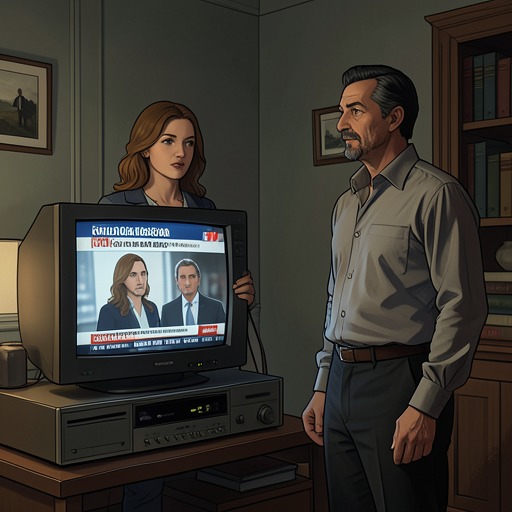
The most consequential break in Jack and Emma’s relationship comes when he reveals her private information on television. Emma is unable to look away as his voice continues, listing secrets she had entrusted to him: she wears lucky underwear on first dates, borrows designer shoes from her flatmate while passing them off as her own, pretends to kick-box, is confused about religion, and worries that her breasts are too small. The particulars make the exposure more than a general disclosure. They turn small, vulnerable admissions into material for a public audience, and Emma experiences the moment as a humiliating loss of control over her own story.
The television revelation throws their unequal exchange into stark relief. Emma had shared her thoughts and worries with Jack; later, she tells him that he hardly told her anything about himself. Jack describes himself as a private person, but Emma insists that the disparity matters: she had shared everything, whereas he had shared nothing. Her complaint is not that privacy should have no place in a relationship. It is that he accepted her confidences while withholding the context that might have helped her understand his silences. In that light, the television breach compounds an existing imbalance: Jack knew intimate details about Emma, while she did not know what he was protecting.
Alice, Privacy, and a More Personal Confession
When Jack finally explains why he had been in Scotland, Emma first fears that he had gone to visit a woman. He clarifies that he went to see a child. Her name is Alice, and she is four years old. The revelation changes the meaning of his earlier secrecy: Jack says that he could not have shared this lightly, and Emma recognizes that his description of the matter as complicated and sensitive had been truthful. He apologizes for not telling her sooner and acknowledges that his silence made her feel shut out; Emma, in turn, says she had been wrong to assume the worst.
The explanation does not erase Emma’s earlier grievance about the imbalance between them, but it gives that imbalance a particular human context. Jack’s privacy is not presented as a mere preference for withholding trivia: at least one major secret concerns a four-year-old child and is, in his view, not something to disclose casually. His apology also recognizes the relational consequence of keeping it: Emma had experienced his reserve as exclusion, even though he understood the information itself as sensitive.
In a later attempt to speak with Emma, Jack approaches her while she is with her parents and asks for a moment. She refuses to talk to him, making clear that the earlier injury has not simply disappeared. At another point, he reaches her across gravel, takes her by the shoulders, and admits that he has always been afraid of the dark. He keeps a baseball bat under the bed in case he needs it. The small, concrete confession is striking beside his public image as a founding father and business innovator. It offers Emma an unvarnished fact about him rather than another account of what she has revealed.
Narrative Role and Significance
Jack’s characterization is built around the contrast between public recognition and private disclosure. At Panther Corporation, he is celebrated through a corporate origin story and introduced as an inspiration to marketers; in Emma’s life, he is first the stranger who listens on a frightening flight, then the man who asks for secrecy, offers a dinner date, kisses her, and finally exposes the confidences she gave him. Those roles do not neatly reconcile. His attentive response to Emma’s openness is genuine in the evidence of his remembered words, but attention alone does not make him a trustworthy custodian of what she shares.
The episodes also make secrecy reciprocal without making the obligations identical. Jack asks Emma to conceal his presence in Scotland, while Emma’s confidence in him rests on having revealed private truths; the later television broadcast violates that trust in a way his earlier request did not. Alice’s story helps explain why Jack guarded some information, and his fear of the dark shows him eventually offering a different kind of personal truth. Neither disclosure cancels the consequences of his earlier actions. Instead, his arc remains shaped by the question of whether intimacy can survive when one person has been made visible and the other has chosen what to keep hidden.